WFWPI UN Office Geneva Co-sponsors Commemoration of the Global Day of Parents
By Léa Petrequin
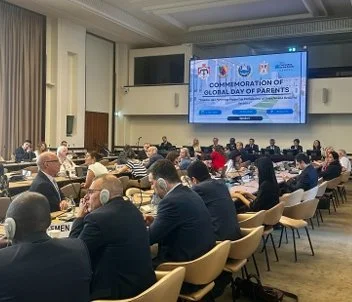
Geneva - The WFWPI UN Relations Geneva co-sponsored the commemoration of Global Day of Parents on June 1, 2026, as a founding member of the new NGO Committee on Family in Geneva. Twenty-five government missions were present.
Since the 1980s, the international community has increasingly recognized the importance of the family as a fundamental unit of society. Through resolutions of the United Nations General Assembly and observances such as the International Year of the Family and the International Day of Families, the UN has reaffirmed that strong families are essential to social stability, human dignity, and sustainable development.
Families provide the foundation for a child’s development by creating an environment of love, happiness, understanding, and security in which children can flourish to their full potential.
Established by the UN General Assembly in 2012, the Global Day of Parents is a timely reminder that parenting is not only a private responsibility, but also a public good with profound social value.
International human rights law has long recognized the central place of the family. The Universal Declaration of Human Rights and the two International Covenants affirm the importance of family life, while the Convention on the Rights of the Child recognizes the family as the natural environment for the growth and well-being of children. These instruments also underline the primary role and responsibility of parents in the upbringing, care, education, and protection of their children.
In this sense, supporting parents is not separate from human rights; it is one of the ways human rights are made real in daily life, said H.E. Mr. Akram Sa’ud Harahshem, Ambassador and Permanent Representative of the Hashemite Kingdom of Jordan.
He emphasized that the family should be understood not merely as a social institution, but as a primary space of moral formation, social cohesion, and resilience.
"In a world threatened by conflict, forced displacement, economic pressures, and rapid social change, parents face growing challenges in fulfilling their responsibilities. Yet they remain the first educators and protectors of children, transmitting values such as respect, responsibility, dialogue, and solidarity. Strong families, he stressed, are not only beneficial to children; they are essential for peaceful societies and resilient communities," Harahshem said.
H.E. Mr. Salomon Eheth, Ambassador and Permanent Representative of the Republic of Cameroon, likewise stressed that the family remains the first school of life, the first place where values are transmitted, and the first institution in which peace and harmonious coexistence are learned and practiced. For Cameroon, the family is not a private reality alone, but a cornerstone of social organization and cohesion.
He recalled that in Cameroon, the Constitution recognizes the family as the natural foundation of human society and places it under the protection of the State.
He also highlighted the diversity of family forms (natural family, legitimate family, single-parent family, extended or traditional family) and the need for policies that support education, healthcare, child protection, and socio-economic empowerment. Experience shows that when families are strong, societies are stronger; when parents are supported, children are better protected; and when children grow up in stable and caring environments, societies are more capable of resisting violence, exclusion, and division.
For him, investing in the family is a strategic investment in peace, development, and human dignity. When families flourish, peace flourishes.
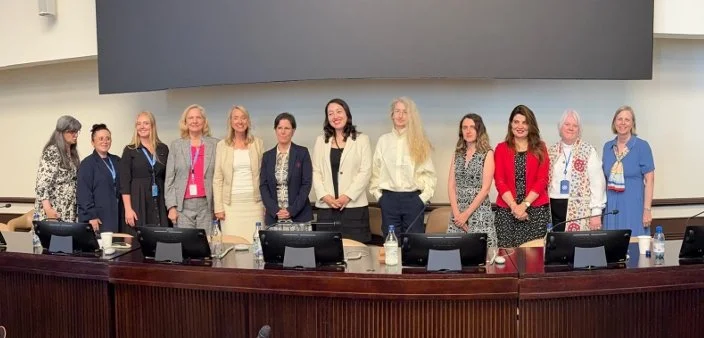
H.E. Mr. Alaa Hegazy, Ambassador and Permanent Representative of the Arab Republic of Egypt, framed the issue through four simple questions that point to a single answer: resilience, social cohesion, and peaceful coexistence all begin with the family. Where do resilience, social cohesion, and peaceful coexistence begin? Why does the family matter for peaceful and resilient societies? Why should we invest in the family as a public policy priority? What do families need today in order to continue fulfilling this role?
Families are the first school of human relations, where children learn to listen, compromise, resolve disagreements, and care for others. Therefore, family support should be treated as a long-term investment in prevention, stability, and sustainable development. He also underlined that family policies must respect cultural diversity while recognizing the primary responsibility of parents in the upbringing and protection of children.
The UN Special Rapporteur on Violence Against Women and Girls, Ms. Reem Alsalem, recalled that families often serve as the first and last line of support, protection, and care.
"International law does not seek to weaken families, but to ensure that they become places where all members can live in dignity, equality, safety, and mutual respect." She also noted that strong and supportive family environments can help prevent violence, strengthen resilience, and support recovery from trauma and crisis.
Alsalem warned that families can also be sites of violence and discrimination, which means that support for families must go hand in hand with accountability and protection from abuse. Studies show that perpetrators are often persons known to the victim, and sadly, they are frequently family members.
"There is a need to look at child custody proceedings and to conduct them in a way that protects the rights and safety of the child, especially where children have been subjected to sexual abuse or coercive control, and where, unfortunately, family courts continue to prioritize contact between a victimized child and an abusive parent without properly considering the best interests and needs of the child. We need to ensure accountability, equality, and protection from violence within the family. We have to do this together and in tandem."
Jenet Jacob Erickson, Family Fellow at Whealty Institute, added an important
developmental perspective: healthy development is relationship-dependent. Mothers and fathers each contribute in distinct but complementary ways to a child’s growth, emotional security, and sense of identity. Her intervention highlighted that motherhood and fatherhood provide an irreplaceable foundation for peaceful and resilient societies. In this view, supporting parents is also supporting the emotional architecture of the next generation.
Evelyn Santos, UN Representative of Youth With A Mission, recalled that when we speak about peace and resilience in the UN framework, we often think of diplomacy, humanitarian action, or security mechanisms, yet family environments are equally decisive.
Within families, peace can be built or destroyed. She stressed that raising children means more than providing food, housing, and education; it also means teaching values and emotional capacities.
For her, families and parents must be seen as a long-term investment in resilient communities and peaceful societies. Finally, strong and stable family environments are closely linked to progress across the three pillars of the United Nations: human rights, sustainable development, and peace.
By placing parents and families at the heart of public policy, the international community can help build societies that are more just, more resilient, and more human.