
Amid Budget Cuts: WFWPI UN Office Proposes to Maintain UN Women as a Distinct Agency
New York - The Women’s Federation for World Peace International (WFWPI), asked the UN Secretary General and the member states to reconsider its plan to merge the UN Women with the UN Population Fund Agency as part of its cost-cutting measures under the UN80 Initiative.
In an official statement submitted to the Secretary-General, member states, and UN missions, WFWPI expressed reservation on the planned
structural merger and recommended that the UN Women remain a separate, visible and adequately resourced United Nations entity.
As the two entities perform distinct but complementary functions, merging with UNFPA would likely subordinate a broad gender equality mandate to a highly specialized reproductive health agency, the WFWPI statement said.
The UN Women was created as an independent entity in 2010, through UN General Assembly Resolution 64/289, to give gender equality its own visibility, and provide coordinative, operational and normative capacity, after years in which the issue was dispersed across several UN structures. It works at the national, regional, and global levels with gender ministries and women empowerment organizations.
The UNFPA, meanwhile, works mainly at the national level with ministries of health and planning, demographers, and sexual and reproductive health and rights organizations. It focuses on reproductive health services and data collection.
WFWPI said that if the UN Women is merged into a larger structure, it may derail ongoing mandated programs on women’s leadership and participation in public life, women’s economic empowerment, ending violence against women and girls, and women, peace, and security alongside humanitarian action.
WFWPI further noted that the UN Women is an integral actor in the achievement of the 2030 agenda of the Beijing Platform for Action and remains a comprehensive foundation for advancing women’s participation and well-being across education, economic life, decision-making, peace and security, protection from violence, health, environmental stewardship and institutional development. In this regard, the Beijing Declaration and Platform for Action should remain a principal
anchor of the UN Women's mandate.
Recommendations
In the spirit of constructive reform, WFWPI proposes an alternative model of enhanced coordination without structural merger, including:
Joint policy frameworks and coordinated country-level programming where mandates intersect;
Reducing duplication across departments;
Shared administrative services, including facilities, procurement, information technology, human resources and appropriate financial systems;
Integrated data collection, interoperable monitoring and evaluation, and shared evidence platforms; and
Joint funding mechanisms for specific programs, while retaining separate mandates, governance, executive leadership and institutional identities.
WFWPI also encouraged the UN Women to ensure that its public communications and policy advocacy remain balanced, inclusive and firmly grounded in
intergovernmental agreed frameworks to empower women and girls.
UN Women is encouraged to strengthen credibility, trust and effectiveness through inclusive consultation with Member States and diverse civil society
organizations and local communities; clear, consistent and balanced communication; rigorous accountability; and programming responsive to differing national, cultural and religious contexts.
While recognizing the need for responsible reforms in the wake of the UN's financial constraints, WFWPI said that "keeping UN Women as a distinct entity will ensure that women are not merely beneficiaries of policy or variables within demographic projections, but actors with inherent dignity as mothers, leaders, decision-makers, and equal partners in the development of society."
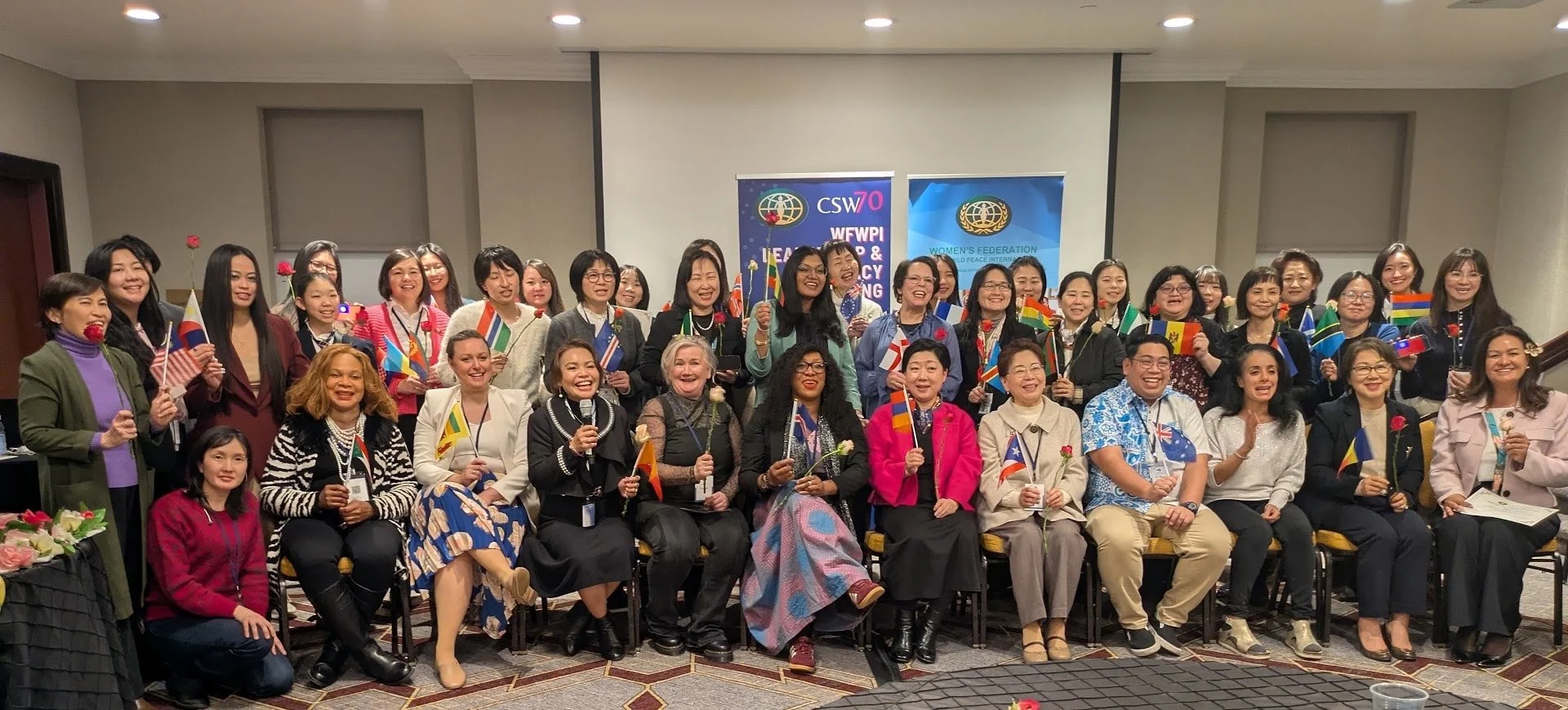
WFWPI UN Relations Office proposes to maintain UN Women as a distinct agency in order to highlight far-reaching and comprehensive empowerment programs for women.